
Residency Fellows
2025
Dec. Essi Kausalainen + Mikko Kuorinki
Nov. Sara Blosseville + Victor Gogly
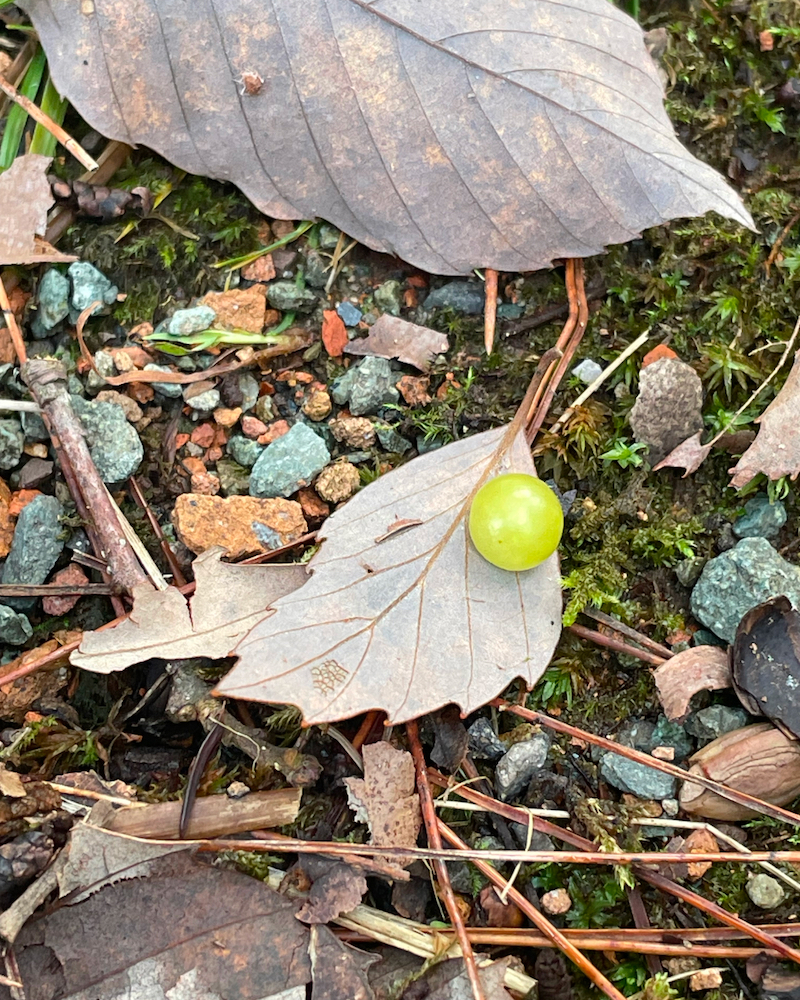
My stay at Hamuro residency was filled with a sense of feeling at home in the rurality, yet in an unknown territory with new beings met every day. The local farming community is lively and the daily encounters with them had me thinking about the ways we process our immediate surroundings to support our human lives. This took me back to an important figure of permaculture: Masanobu Fukuoka. His essay, « One Straw Revolution » favors a do nothing ~ or more precisely, a none harmful ~ farming style. It stuck with me all the way to this day in my artistic practice and approach to curating. I am interested in exploring ways to apply permaculture sustainability intentions to art making and curation. Fukuoka’s words « the birds sow for me » were my companions during the residency.
My heartfelt gratitude to Shoji Kato and Toshinori Oka, for their invitation and hearthy hosting at the residency. I am also grateful to the Scandinavia-Japan Sasakawa Foundation for supporting my travel and work.
Sara Blosseville is a visual artist from France, living and working in Vantaa, Finland. Her works can be considered as explorative diaries that take the shape of installations, garments, tools, quilts, blogs, fanzines and soundtracks. She co-organises the publishing festival « Under The Leaf – Art Book Fair Helsinki », and together with Victor Gogly, they created the experimental curatorial platform « Light-harvesting Complex » that dwells in a greenhouse.
—
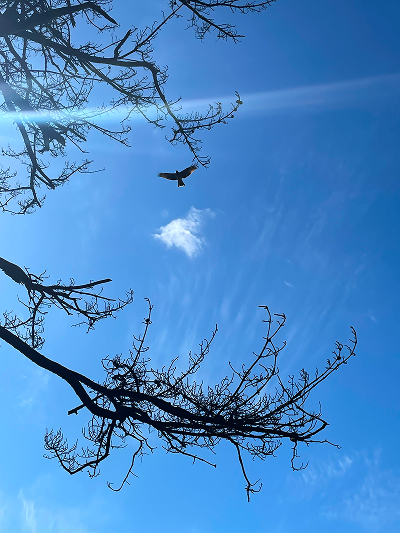
My stay at Hamuro brought new flavors to my practice, new sounds related to the house and surroundings. I came with an electric guitar, a portable radio and recording equipment. The resulting recordings are quite site specific to me and contain a dream-like version of my stay in Japan. I also really enjoyed playing the piano there and spending time listening to the cd’s I bought in Tokyo.
Meeting some local people, tasting new cuisine, being in a new landscape really nourished my practice and filled my heart. I left with great memories. I am truly grateful to Shoji Kato and Toshinori Oka, for their invitation, support and hosting at the residency
Victor Gogly is a musician and visual artist from France, living and working in Vantaa, Finland.
His music explores blues in an abstract way, leaning toward ambient music territories, field recording and noise. He mainly plays guitar, an instrument that he tinkers with objects and detuning in order to achieve certain sounds, not hesitating to bury it in layers of effects. His interests also go to different instruments such as piano and various electronic devices.
Within his visual practice, he endeavors to capture both the textural and immaterial transitions between human, non-human, and animal relationships to one another and our world. On painted canvas as well as through collage and sculpture, those beings transform and interact with one another within spectral spaces where physical boundaries are obfuscated, and mankind’s relationship with nature is re-examined, offering the possibility for change.
Oct. Eeva Rönkä + Jani Anders Purhonen
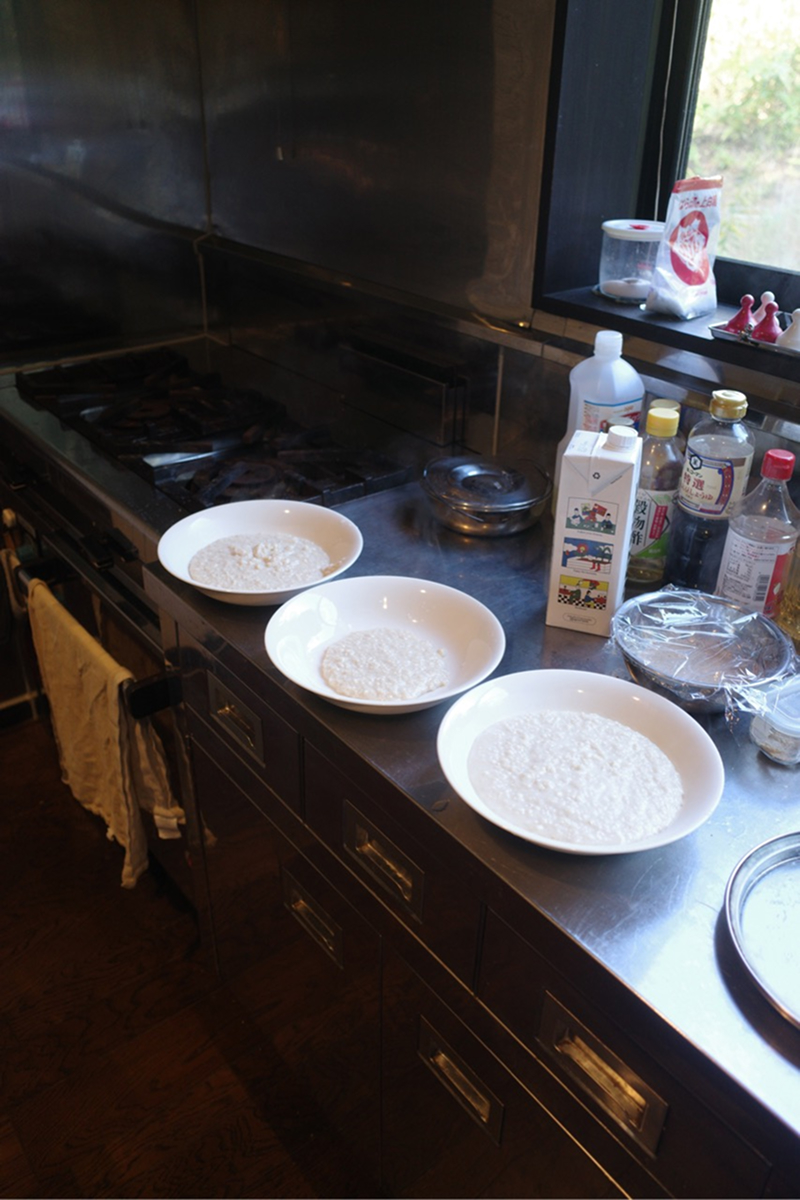
Looking at some pictures from Hamuro times…
baby collage in the alcove
gurutto 2 sentopia
curiously, our salt limit is similar to max herbaceousness
regaining conciousness
opening koji rich rice drink
Hot Spring Boiled
Classic Bath ice lolly
but I prefer to dry age like dry humour
Toshi’s glasses like acorns in the orange sun
night time arrives in 15mins
mukadeth
rest in the forest of creation
the best wild yeast catcher
a nuka bed of roses
water on the floor; shakudani stone
starch binds us
soba water (sacred?)
ono spring water
p wave felt in Kaga (se on tärkeä meille)
“mä mietin vaan Suomee”
“ja Japania”
it is fermentation
Great thanks to Scandinavia-Japan Sasakawa Foundation for travel support
Sep. Charlotta Östlund
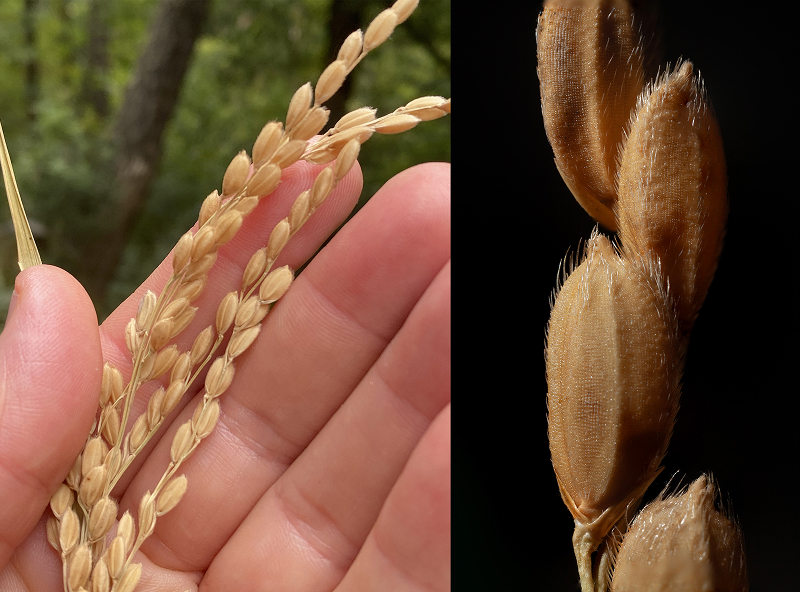
During my month in Hamuro, I allowed myself to settle into a calm everyday rhythm: walking, observing, absorbing, letting my thoughts drift in any direction. In the house I spent my time thinking, sketching, testing ideas with plant materials, and photographing. In a place where many aspects— including the spoken language—were unfamiliar, I felt that my sensitivity toward my surroundings sharpened, and my inner calm was strengthened.
The ceramic studio awakened in me the lust and opportunity to reconnect with a medium I hadn’t used for a long time, but which originally sparked my interest in Japanese culture. I left clay behind many years ago, because over time I found my own artistic language through other materials. Plant material has been central in my work for a long time, so I was excited to discover glazes in the studio that contained rice and wood ash. Using them became a way of bringing some of the local plants home with me. I plan to incorporate the ceramic pieces into future works.
I am grateful for the opportunity to be present when ikebana sensei Anezaki arranged flowers at Beniya Ryokan. Watching her work, and talking with her about the handling of plants in relation to life in a broader sense, was a deeply meaningful moment for me.
Of course, the stay involved much more, but I will leave it here. In lack of a better word, I would describe my time in Hamuro—and my additional travels in Japan—as making me “denser”: denser in the sense of gaining deeper understanding.
A warm feeling comes over me when I think of all the people I met: Aaron Browne, Sayo Hashimoto and the rest of the friendly staff and users of the ceramic studio, Noriko Yamaguchi, those who greeted me on my walks through the village, and many others.
My sincere thanks go to Shoji Kato and Toshinori Oka, as well as the entire Hamuro team, for inviting me and taking such good care of me. I am also grateful to the Scandinavia-Japan Sasakawa Foundation, Konstsamfundet, and Taike for supporting my travel and work.
Charlotta Östlund
Aug. Anastasia Isakova
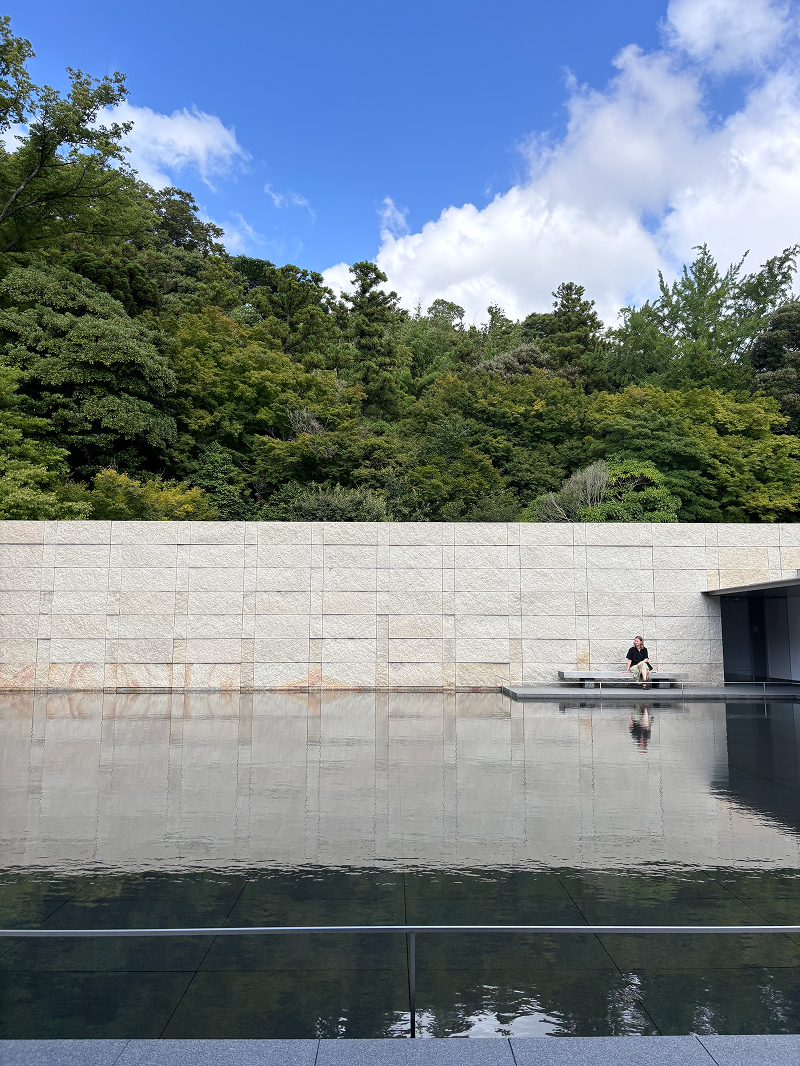
I spent August 2025 at Hamuro residency with my partner, and my stay was marked by quiet but profound experiences that will continue to shape my practice as a curator.
What I remember most is the presence of the forest around the beautiful residency house. The sound of insects created a meditative rhythm, a reminder of time moving slowly and of being part of something larger. I learned these were often suzumushi crickets, whose sounds mark autumn. This deep awareness of seasonality in Japan, woven into food, festivals, crafts, literature, gave me a new sense of how time shapes beauty and invited patience and presence.
The residency also taught me to see differently. At home my vision often narrows under deadlines and other people’s opinions, but in unfamiliar surroundings I began to slow down and observe without the urge to interpret. I noticed shapes, textures and details I might have overlooked. This revealed a quiet beauty in many things around, something I want to nurture as a person and working as a curator.
The concept of mingei, “the art of the people”, resonated strongly. In Japan, design and craft are part of daily life, carrying history and spirit as much as function. Visiting the Kutani Kiln Museum in Kaga deepened this reflection. Traditional crafts are not static heritage but living practices. I was also inspired by Keijiban, a tiny open-air gallery in Kanazawa that transforms a bulletin board into an exhibition space. It made me imagine similar micro-galleries in Helsinki, woven into the city’s everyday life.
My residency was full of modest but meaningful experiences, opening new ways of seeing and thinking. I am grateful to Shoji Kato, Toshinori Oka and Masateru Yoshimura for this opportunity and their generosity, and to the Scandinavia-Japan Sasakawa Foundation for the travel support.
・・・・・・・・・・・・
Anastasia Isakova is a curator with a background in exhibition studies and philology. She studied curating at the Academy of Fine Arts in Helsinki, where she completed the Praxis Master’s Programme in Exhibition Studies in 2018. Before that, she studied art criticism and Finno-Ugric philology and literature at St. Petersburg State University. Alongside her curatorial work, she has been part of the independent curator group P14, through which she curated exhibitions at the galleries Kallio Kunsthalle and Oksasenkatu 11 in Helsinki. From 2018 to 2025, she worked as a curator at Amos Rex Art Museum in Helsinki, where she was involved in developing and curating the museum’s exhibitions.
Jul. Jani Ruscica
The Hamuro air residency was for me intensely productive, not only on a very practical level, but also on an intellectual and spiritual level.
The vicinity of the Ceramic studio allowed me to develop objects from a series of new works tentatively titled ‘Phantom objects’. Under the guidance of Aaron Browne and Sayo Hashimoto, I was able to complete four new works in ceramics, all making use of different techniques and methodologies. Ceramics is something I haven’t worked with for over 25 years, my only experiences working with clay date back to high school and the extracurricular ceramics workshops that I took then. I was intrigued to discover the power of body memory, the distant familiarity of the material, all the remembering that took place. This was a deeply felt experience, and I am honestly amazed at what I managed to accomplish whilst working at the Kanaz Ceramic studio. The four ceramic objects are part of a larger body of works eventually encompassing more than 200 objects.
The studio space at Hamuro also allowed me to develop work on paper. What initially was meant to be a continuation or variation of current and existing works on rice paper took an unexpected turn, I believe much thanks to local stimuli, something seen and experienced whilst travelling around Japan prior to arriving at Hamuro. So instead of printing I ended up making the new works on rice paper with frottage technique. Similarly indexical in nature as printing, frottage consists of rubbing the paper with color, and at Hamuro I chose to work with dry pastel. Just like my previous print work, the 1:1 scale seemed important, I want my prints, and now my frottages, to maintain an indexical and 1:1 relationship to the thing they are a trace of, a ghostly imprint of. The resulting works (part of a series I am continuing in my studio in Helsinki, and will later exhibit at Galerie Anhava in an upcoming exhibition in January 2027) were made with found objects or detritus, locally sourced from the beach, from the Hamuro house, from the forest surrounding the house, etc. This to me is important, as this way the prints function much like photography, in their ability to trace and record not only time, but also material substance/presence.
Beyond what I practically made, the residency was also an important period to process future work, namely a suite of portrait videos involving a butoh dancer. Whilst in Tokyo I managed to contact the Kazuo Ohno Foundation and get access to material from their archives, order books, etc. Ohno, being a seminal figure in the development of Butoh, and someone whose work I deeply admire, seems like an important figure to study more in-depth while preparing this new video work. The opportunity to travel to Japan, for the first time in my life, certainly gave more depth to this research.
Needless to say, the residency, as usually is the case, also facilitated an intense time to see and experience a wealth of things, a lot of which also seemingly unrelated to any specific work. So influential were not only museums, spaces, places, events, but also an innumerable amount of other things that will surely have a huge impact on my thinking and making beyond the rational and conscious.
Jun. Sini Pelkki
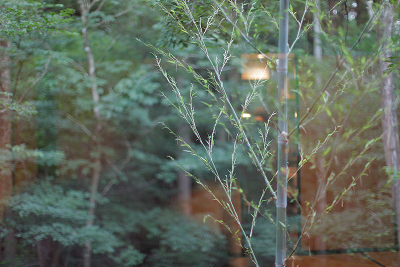
During my stay at Hamuro, the leaf house I explored the experience of being there from the skin level, from the floor through the windows. A moment in the form a stay, a moment of a vivid pause in movement.
The month spent in Japan continues to resonate and has a space in my mind where I return to. At Hamuro I continued to work with my new moving image work. The silence and rhythm in and outside of the house provided guidance and a path in the forming of the ideas further with the new work.
I want to thank Shoji Kato, grateful for all the help, guidance and generosity also to Toshinori, Kato Sumiko Foundation Project and Masateru Yoshimura. Additional warmth and thank you to Keiko Yamamoto. Thank you to The Finnish Cultural Foundation for supporting the residency period.
Sini Pelkki
May. Arttu Merimaa + Miina Hujala
PRESENT: ABSENCE
There is a pile of different kind of flyers on the front room of Hamuro. Previous residents have left them as perhaps suggestions of places to visit, but also as traces of where they have been. One of these places was house museum of Dr.Suzuki, a zen scholar that made zen thinking available in English and for Western audiences.
Suzuki, whose (beforementioned) museum we later visited wrote: “Art impulses are more primitive or more innate than those of morality. The appeal of art goes more directly into human nature. Morality is regulative, art is creative. One is an imposition from without, the other is an irrepressible expression from within. Zen finds its inevitable association with art but not with morality. Zen may remain unmoral but not without art.” Suzuki goes to explain how imbalance or asymmetry or simplification, ideas that feature Japanese art and culture emanate from the truth of the Zen, of ‘the One in the Many and the Many in the One’”.
Residencies are layered spaces, occupying visitors as people staying for a while, spending periods of time in the same spot, seeing the same (but always different) view, following the same (but always different) routes, sometimes taking cues from each other’s steps. When we entered Hamuro it was late spring, the month of May as the utmost perfect time to visit for us coming from the North, we got a fast-forward to summer, temperatures at the warm 20-27 degrees Celsius and moisture at a decent comfortable level. Climate does play a role, we are creatures that require habitats, and relocating to a house that was built a century ago seemed to offer a haven for us, to mend ourselves with the aesthetic pleasure if offered, nothing too much, everything just as it should be. This quite rare feeling came from allowing oneself to be a visitor, someone that takes in what is there, experiencing it. To discover things beautiful is beautiful. Our 4-year-old had long bath sessions, and we stayed up late looking from the scenery window amazed by seeing a fox, two boars and a Japanese draft flying squirrel, all during one night (!).
We found a new daily rhythm, a routine perhaps, of taking drives each day to some ‘place’. With our Suzuki car we visited second hand stores (mostly 2nd Streets), temples (our favourite being the moss-one), beaches (with sunset and with waves), some museums (of course), sometimes just looking around (just sitting at one spot when our 4-year-old took a nap). Sakai, Kanaz, Awara Yunomachi, Fukui, Mikuni, Yamanaka, Oshima, Kanazawa, Hajimo, Kaga, Eiheiji, Kanayama. I write down places that have names (many places don’t have names). I write a note to my notebook: “About travel – when you don’t know what you should see, you see it all.” [In Finnish originally: matkailemisesta: kun ei tiedä mitä pitäisi nähdä, näkee kaiken.]
I think of the people that suffer (I think) of ‘misoneism’ – the fear of the new and the unknown. As I see it, everything is unknown at some point, and perhaps for us that work with (or in) art, we look for turning things assumed as known to being unknown. Residencies are sometimes possibilities to do that, to think how am I, where am I, what does my days consist of, what do I consist of. In Hamuro we listened to Jazz, played Totoro Uno cards, looked the rapid growth of the bamboo, I read a book on ‘absence’, I draw drawings which our child then dipped to water outside that was collected from the roof to this cavity in the ground. Then smashing the mush of the paper pulp to a ball and letting the smashed paper ball to dry in the sun on the backside of the house.
‘Vain rikkinäinen astia tietää miltä tuntuu olla ehjä.’ [only a broken container knows how to be whole.] Perhaps I have heard this some place? But I felt this urge to think how Zen doesn’t question intuition. That what is effortless. If you are hungry, eat. Buddhist monks weren’t fat because making sugar or butchering took more effort than picking mushrooms. This I read some place and reformulated it here. But also, if you want to make an effort, please do so. That is zen as well. I am aware that staying away from something is an effort. A day will be spent, a life will be lived. No purpose there to begin with, neither to be left with. I think of what one can leave out. Byung-Chul Han writes in the book ‘Absence’: “In Far Eastern languages, the subject is often left out altogether, so that the verb stands alone, making an unambiguous assignment of an action to a subject impossible”. When writing in English I yearn for the way to say things with just one word, without announcing ‘who’ does it. I know, I can do this with my maternal tongue (in Finnish): ‘Sataa’. This just happening can have it’s say. Han references a book by Yoshida Kenko, Essays in Idleness, where the author feels a strange sensation when “jotting down nonsensical thoughts”, this because, as Han describes, something happens without active doing, without intention, or a will, there is no one ‘doing the rain’, we can leave it out.
In Hamuro, I was there. I was undetermined, I was ‘jotting down’ life as it went. And what a privilege that was.
text by Miina Hujala
https://www.poriartmuseum.fi/
www.hiap.fi/collaboration/connecting-points/
www.alkovi.site
—
My residency focused mainly on doing curatorial research and visiting Japanese art institutions of the near by cities, such as Kanasawa, Kyoto and Osaka.
In addition to this I was able to engage in my other true passion: thinking about making clothes and scavenging for vintage fabrics. I am by no means a pro dressmaker or sewist but I enjoy making things and looking for fabrics and garments that could last for multiple generations. I source vintage fabrics from flea markets, old factories and shops and wherever I can find them.
Japan is a goldmine for vintage textiles largely because of the rich history in traditional fabric dying, pattern weaving and variety of natural fibers used in clothes making. There is a plentitude of kimonos to be found in second-hand shops and flea markets as well as beautiful rolls of original vintage kimono fabrics in silk, wool, cotton and linen. For me it is interesting to consider the longevity of garments and the clothing traditions in the face of the crippling consumer culture.
I was lucky to spend a day with wonderful local guides Masateru Yoshimura and Hiroko Maeda who took us to learn about the history and present of silk making in the town of Katsuyama. We visited Yumeole Katsuyama, a textile museum located in a renovated silk mill, showcasing the region’s rich weaving history. In addition to that we were able to access a functioning silk factory Higashino Tokichi Orimono which continues to weave silk fabrics using the Habutae technique in Fukui. For me this was an introduction into tangible knowledge related to the histories of the area, of the material (silk) and of the traditions related to textiles. Also, through the visits and the conversations we had, it was interesting to consider histories around textiles in conjunction to women’s histories and societal positions around work and labor since those two seemed to have gone, at least partly, hand in hand.
I am immensely grateful for this day spent in Katsuyama with Maseteru and Hiroko and the gift of kimonos.
Arttu Merimaa
Mar. Apr. Mayumi Niiranen-Hisatomi
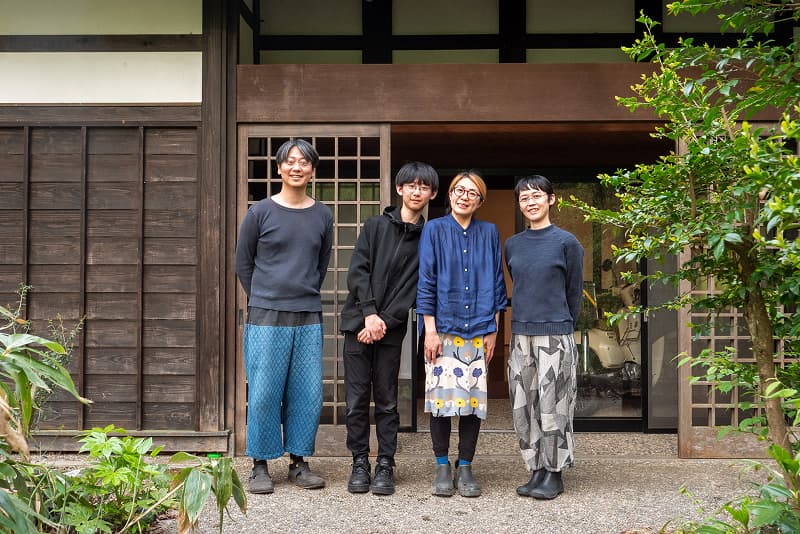
Looking Back on My days in Hamuro / June 26, 2025
First of all, I am Japanese, born and raised in Japan, and I have been living in Finland since 2008. When you go to a foreign country you have never visited, there is first the overwhelming presence of the large subject called “the country” or “the nation.” But since I am Japanese, naturally there was no sense of foreignness during my stay at Hamuro, so my attention was drawn instead—quite naturally—to the differences from the place where I grew up, Kobe; in other words, to the locality of the region. Above all, what I could not help but feel first during my stay at Hamuro was the presence of Sumiko Katō.
Hamuro felt more like a living space than a typical artist residency. It had only one small workroom where it felt acceptable to make a mess. Inside that small space, there were fabrics, dyeing materials, books, pots, and other things Sumiko Katō had left behind. Observing all the objects she would likely never use again was the starting point of my residency. I felt as though I was also looking at a reality that will probably come to me one day. Being surrounded by objects and continually materializing concepts—and seeing what remains when one can no longer work on producing physical artworks—felt like catching a glimpse of my own future while being in that small room. It was a time that overlapped with the questions I am always asking myself about how to deal with all the objects I make and use.
That said, I was determined to use this two-month residency fully, so I couldn’t allow myself to remain only sentimental. Almost as soon as I arrived, I began working. My first attempt was clear: to explore how to preserve the shapes and colors of plants around Hamuro on fabric without using metal mordants.
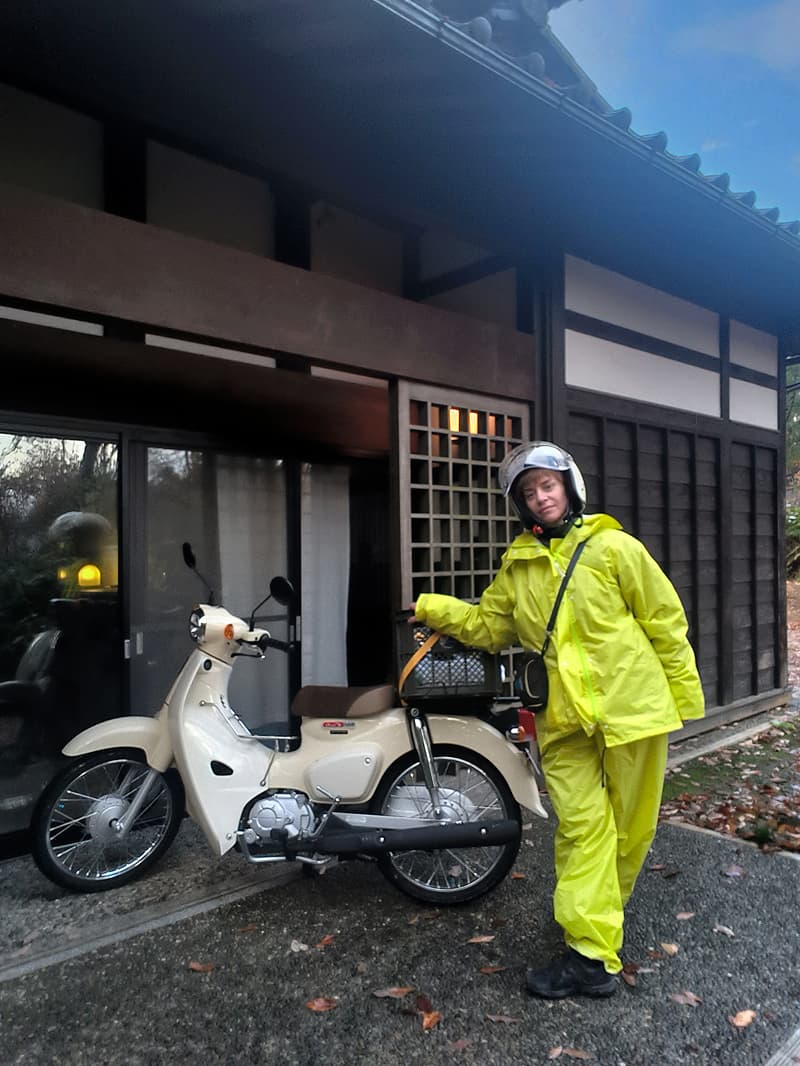
For example, this process required rice bran, so I started by asking a ceramics teacher, searching on Google Maps, and then going out on my Super Cub scooter to find some. During the residency, I kept repeating the cycle of asking, observing, researching, collecting, and transferring the shapes and colors of plants onto fabric—trying different methods of mordant dyeing.
I spent time observing the garden at Hamuro, watching the seasons shift, collecting plants, and perceiving their forms and colors on fabric. Later, I had the chance to meet people who are preserving and recognizing the Mokko-sashi culture, and through this, I was fortunate to meet Miwa Ishimori, a young ama, sea diver. Through this connection, the scope of my work expanded significantly—specifically to encountering seaweed.
Where I currently live in Kajaani, Finland, is inland, so I have no access to seaweed. Precisely because of that, I was determined to work on seaweed printing while I was in Japan.
To be honest, I feel I gained so much from this residency that it’s nearly impossible to summarize. If I were to name a few things, words like “ways of preserving culture,” “ways of preserving artworks,” “Japan’s endemic species,” and “the inseparability of body and land in artistic practice” come to mind.
It may feel like a sudden shift after writing so much about my work, but perhaps the most memorable part of my stay at Hamuro was meeting the Oka family and Ms. Yoshimura, who looked after me. They were such wonderful people—how grateful I am. And to the Jizō statue in Hamuro, I offer my heartfelt thanks.
Mayumi Niiranen-Hisatomi
Feb. Niina Tervo
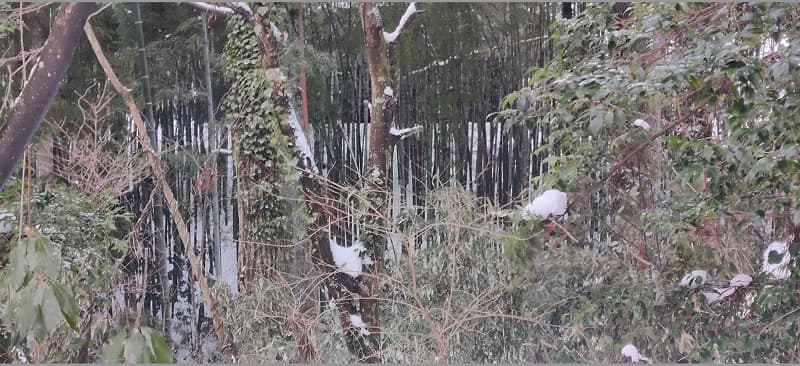
The raven jumps on the thick branches of a dead tree and drips snow, and from there under the branches of a spruce, from there to the upper branches of an unknown bush-like tree and from there to the ground. Back up to the trunk of a small fallen tree, carefully poking the trunk with its beak, exploring, perhaps eating. The movements are controlled and soft, questioning.
white fades slowly from the left, it begins to shine more brightly, water drips in heavy drops, the transformation has no clear boundary
A red light reflects and flashes from a branch of a pine-like tree, although it may be more of a thuja. The dripping of the melting water droplets accelerate, but the leafless trees hold on to them. It rains colors inside the forest. I’ve never seen light reflected like this before.
The blue color of the lower branch is continuous.
stretching water feels lazy and ready to sink into the soil
The sun and water seem to be friends? The sun and the earth seem to be friends. Water and land seem to be friends. Air seems to be no one’s friend, but later with water and animals.
Spring
2024
Nov. Dec. Elina Vainio + Matti Kunttu
ElinaVainio
The six weeks I spent at Hamuro were characterised by a certain kind of ease in terms of how new work ideas kept surfacing and how I went about experimenting especially with washi papers, a variety of starch pastes, natural pigments and corrugated surfaces.
Now looking back, I associate this ease of working to have had something to do with the independent, artist-run character of this micro residency initiative, where I didn’t feel any explicit or implicit expectations related to production, networking or visibility that come with the more institutional residencies. I also enjoyed becoming a temporary student of the Kanazu Sosaku no Mori pottery classes and learning from instructor Aaron Brown.
I want to thank Shoji Kato, Toshinori Oka and Katsunobu Yaguchi for opening doors to many places I wouldn’t have accessed otherwise. I would also like to extend my thanks to the Finnish Cultural Foundation for the Mobility Grant and the Kone Foundation for supporting my work.
Matti Kunttu
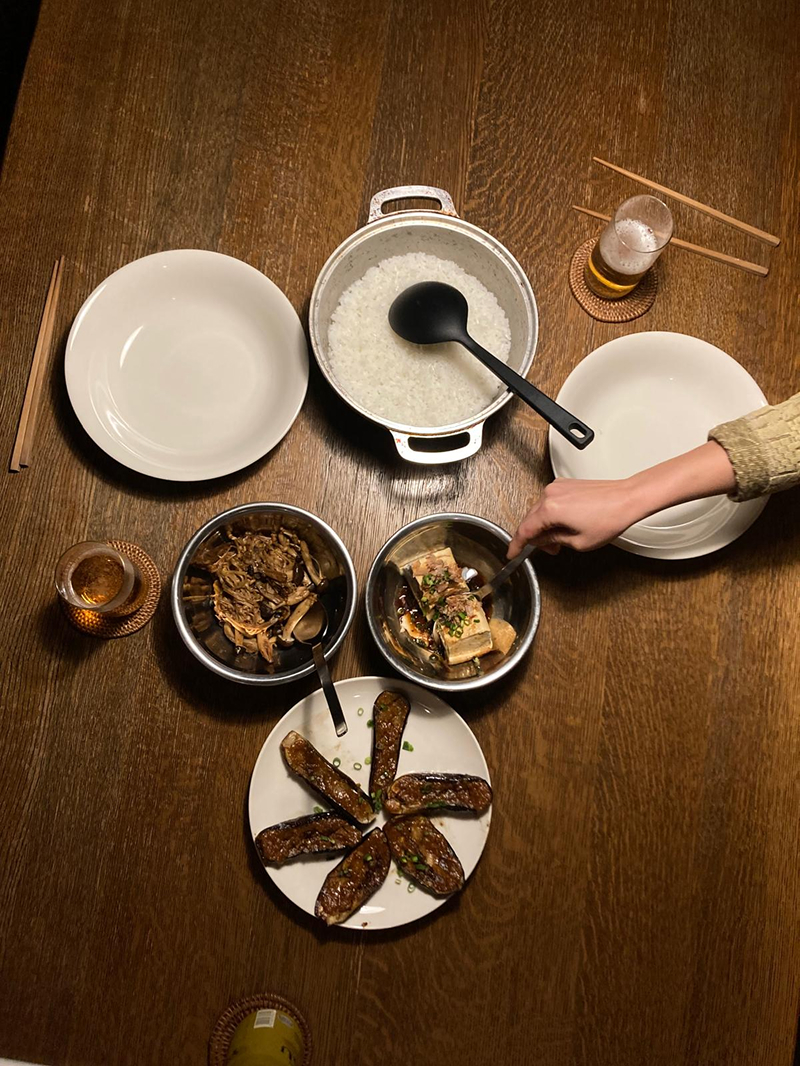
Staying at Hamuro meant settling into a simple rhythm that mostly consisted of going for walks, working, getting groceries and cooking. What a rare treat!
Oct. Mikko Kuorinki
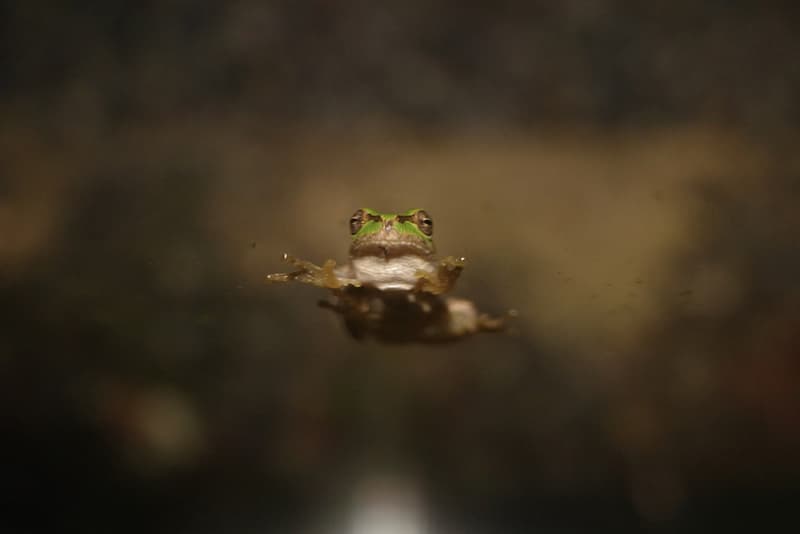
light lays on the leaf
the leaf holds the light
the light plays with the wind
with the hole on the leaf
when i wake up drooling on the floor
a praying mantis carefully
explores the surface of insect net right in front of my eyes
dust settles and we wait for the melody to signal the beginning or the end
air is let in
screeches of various beings
closer and further
commuters
i can’t help but make an image out of it again
Sep. Marja Ahti
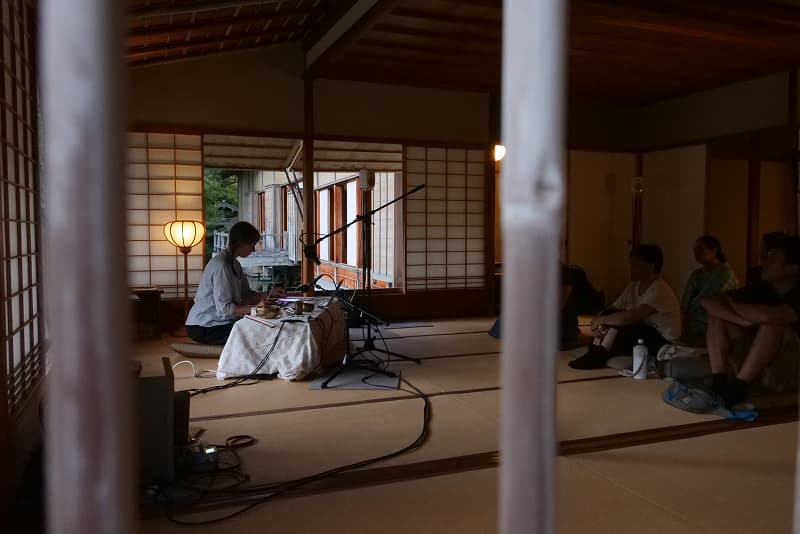
During my one week residency at Hamuro, I spent my time recording the landscape in the immediate vicinity of the house during different time periods of the day and night. It was September, the active season of the suzumushi cricket, whose loud, constant chiming set the mood throughout the week, accompanied by sounds from other birds, insects, occasional traffic and nearby work sites, creating a static mood, yet changing subtly with the rising and setting of the sun, the waking and sleep rhythms of the beings in the vicinity and on a distance. The recording sessions were also occasions for practicing listening and sitting quietly and attentively through durational recordings.
I made two performances in Fukui during the residency — both curated by Shoji Kato. The first was in the beautiful pavilion of Yokokan garden in Fukui city. The event was titled ”Setting and rising” and took place on the threshold of dusk, with the waning light as a backdrop to the event. The sounds reflected this transition — opening with a bright and percussive composition that gradually develops into a deeper, meditative mood based on slow pulsating waves and delicate textures. On the occasion of the autumn full moon, the second event “Tsuki”, I performed a few recent electronic pieces related to nocturnal themes alongside another version of my current piece in progress “Touch This Fragrant Surface of Earth”, as an offering to the moon.
Aug. Ki Nurmenniemi
A Research trip into the Inner Sanctuary
My time at Hamuro, in August 2024, provided me with surprise gifts that keep on giving.
Oh, the thrill of having two weeks to fully focus on my research, and to have the whole Hamuro house to myself!
Before the trip, I had imagined Hamuro to be a sanctuary for conducting my academic research in solitude, to dive into a total “monk-mode”. My plan was to plow through heaps of academic articles and interview data. Hamuro would also provide a new case study for me, as I had been invited to imagine this organic communal structure, this micro residency, into being alongside a group of artists that I admired. What a gift!
This gift of time, space, and residency community turned out to be so much more than I had imagined. I did spend long hours reading and reflecting on the research that I had maintained on slow burn for the past couple of years. I did engage with the environment, unable to take off my social scientist’s lenses. But…
Residing at Hamuro also provided me the opportunity to truly take a pause and quiet the external and internal noise. In the handsome old house cocooned by a forest I was able to research my inner landscape, study its sanctuaries and battlefields. It was a different kind of monk mode that I had had in mind. This meditative period, spent mostly in quiet solitude, brought me back in contact with my true creativity, the currents of free imagination. And this is the kind of reality-shifting force a researcher, much like an artist, truly needs.
However, instead of solitude, my stumbling into the river of creativity happened thanks to the fact that I was asked to share my work with the local community. As this was at the beginning of Hamuro’s first residency season, and what I was doing (researching artist residencies) was hardly going to attract a large local audience, I ended up improvising an intimate artistic workshop that could foster both connections with other human beings and allow them to connect with the immediate surroundings of the residency in unexpected ways.
Taking notice of the abundance of sunlight and the lush botanical life surrounding the residency, I decided to arrange a mini-workshop for creating cyanotypes with local plants. Cyanotype is a very easy yet enchanting method for reconnecting with the elements and with one’s environment. The workshop was organised with just the closest friends of Hamuro – Toshi, Azusa, and their teenage son – but the four of us really threw ourselves into the task of magical image-making.
We started the workshop by discussing the technique and its origins. I told how it had been used, among other purposes, for scientific cataloging of plant life. For some inspiration, I brought up the incredible work of Anna Atkins, who adopted this method from its inventor, her friend John Herschel. Atkins developed the art of cyanotype further in the mid-19th century. She was able to bring out the characteristics of plant species with a keen artistic eye. This was also my goal: to celebrate the many fabulous plants of the Kanaz forest and feature them in an artistic light.
After a playful plant gathering excursion, during which I got the chance to learn more about the local plants and insects, we spread our catch over Hamuro’s long table. It quickly turned into a piece of art in itself, a collectively created composition. Over the course of the next few hours the composition dynamically evolved as everyone created their own plant photograms with flowers, leaves, twigs, even wings left behind by a cicada. It was exciting to watch how everyone’s compositions appeared (rapidly!) on the light-sensitive paper under the intense brightness of midday sun.
To me, it was fascinating to see how everyone created wildly imaginative compositions, making use of unexpected material elements, strong contrasts, and ample empty space. Everyone had their own, immediately recognizable aesthetic language, their unique handprint, even though it looked like we were all just tossing plants on sheets of paper. We created dozens of prints, which, once dry, were organised into a temporary mini exhibition on the long table.
For lunch, Azusa had brought onigiris and miso soup, and sharing them with the family, after all the fun, is one of my most wholesome Hamuro memories.
But it was after the workshop, that I was struck by a sudden lightning bolt of creativity. With a large piece of leftover paper and a couple of hours of sunlight left, I realised I would be able to try out creating one very large cyanotype. Inspired by the others’ compositions, I used the light-sensitive liquid to paint abstract forms on the paper. As soon as the liquid had dried, I hurried outside as there was no time to lose with the fading light. I used a ton of plants to make a composition and then I just had to wait for a short moment. I was suddenly very invested in how the piece would turn out and felt butterflies in my stomach.
Only the bathtub would be large enough for rinsing this baby, so there it went. What eventually came out after proper rinsing and soaking was my first large-scale cyanotype piece, something that I hadn’t intended on creating at all. I realised that I had had the time of my life, just giving myself a gift of spontaneity. I didn’t have the time to overthink why I was making something or what to do with it afterward. I realised that it had been a long while since I had tapped into this kind of spontaneous creativity, and felt re-energized.
Of many sweet memories and highlights, the spirit of this August afternoon is something I cherish in my inner sanctuary. Not only did I learn that collective image-making with plants is a great way to connect with people and places, but that my academic work, too, calls for this kind of free-spirited energy to be rekindled with a creative spark.
This, to me, is one of the true gifts that residencies can offer: surprises that nudge one off the beaten path and towards something new, something that one couldn’t even have imagined.
Jun. Jul. Tuomas A. Laitinen + Emilija Škarnulytė
Emilija Škarnulytė
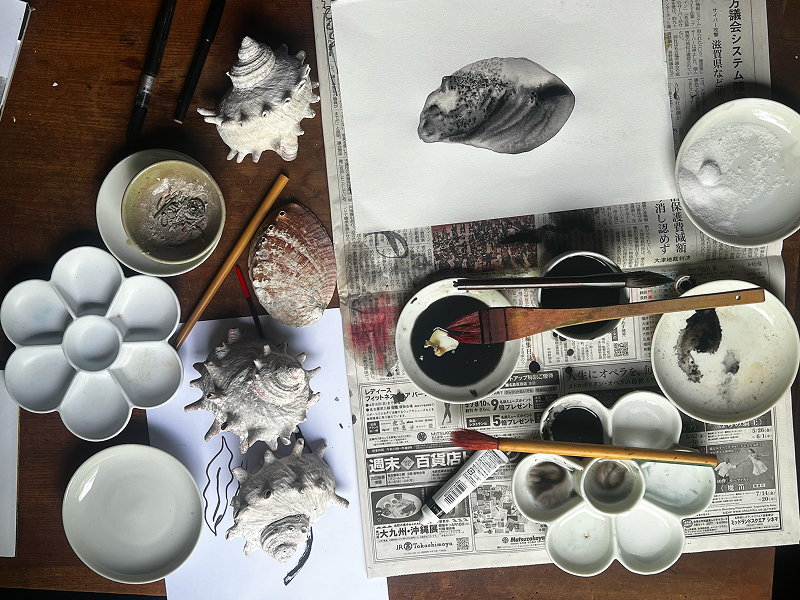
Japanese Turban Shell (Sazae / サザエ)
&
Abalone shell (Awabi/アワビ)
ink drawing on paper
2024 June Hamuro